FluxOps
A Modern Internal Operation Dashboard Experience for Airport Crew
Tools Used
Role
Figma
End-to-End Designer

The Problem
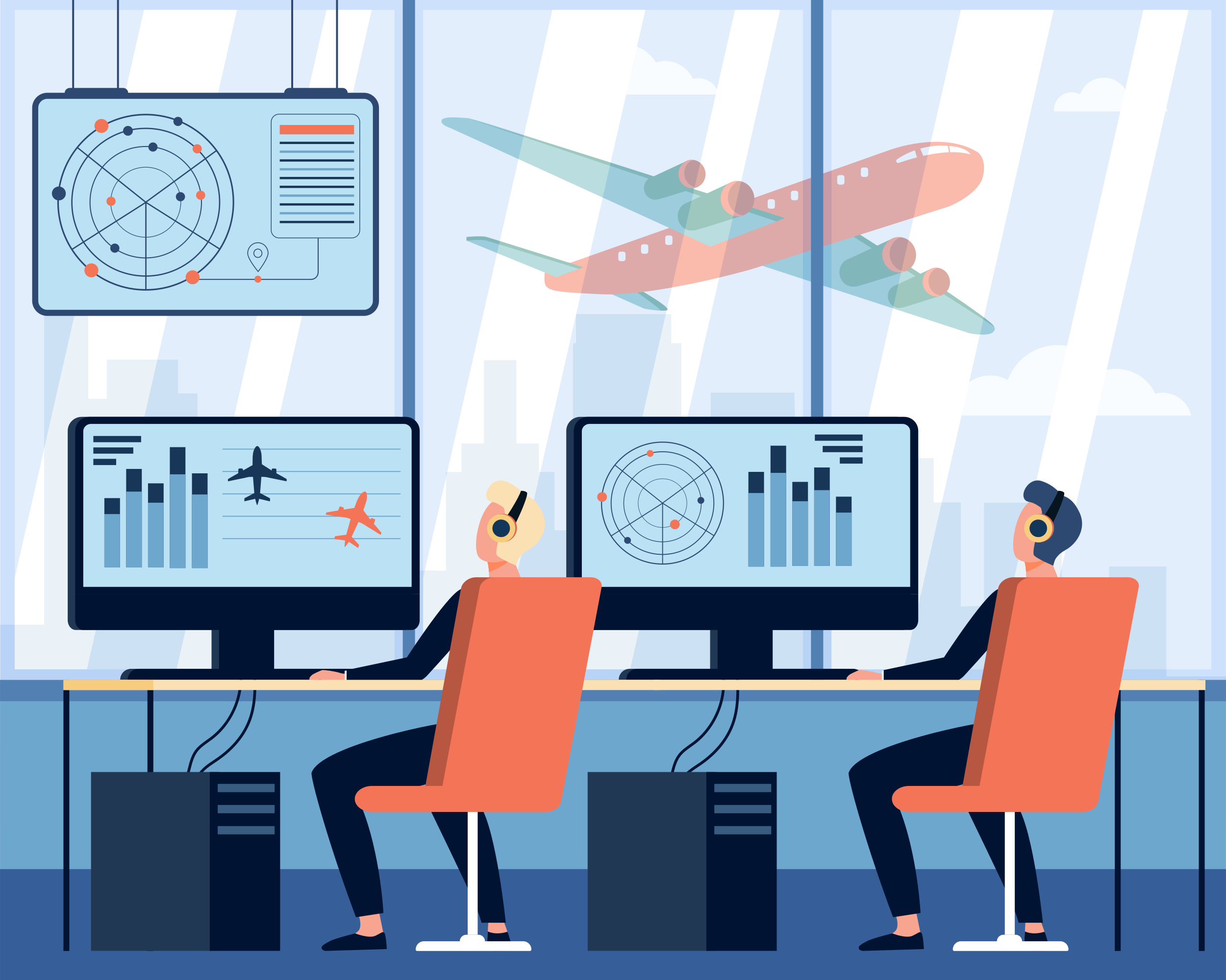
In high-pressure airport operations, dashboards fail when they try to show everything. FluxOps was intentionally designed to show less. By removing non-essential charts, maps, and alerts, the system focuses operators on actionable states, confirmations, and coordinated responses across airports. The goal was not to build a visually impressive dashboard, but a system that performs reliably during disruption.
Design Philosophy
FluxOps was designed as an Operational Control System, not a traditional monitoring dashboard.
Every screen prioritizes decision-making under pressure by reducing cognitive load and eliminating non-actionable data.
The interface follows a clear progression from Situational Awareness to Action and Confirmation, ensuring operators can respond quickly without navigating unnecessary layers or waiting for supervisory approval during critical moments.
The Design & Decisions
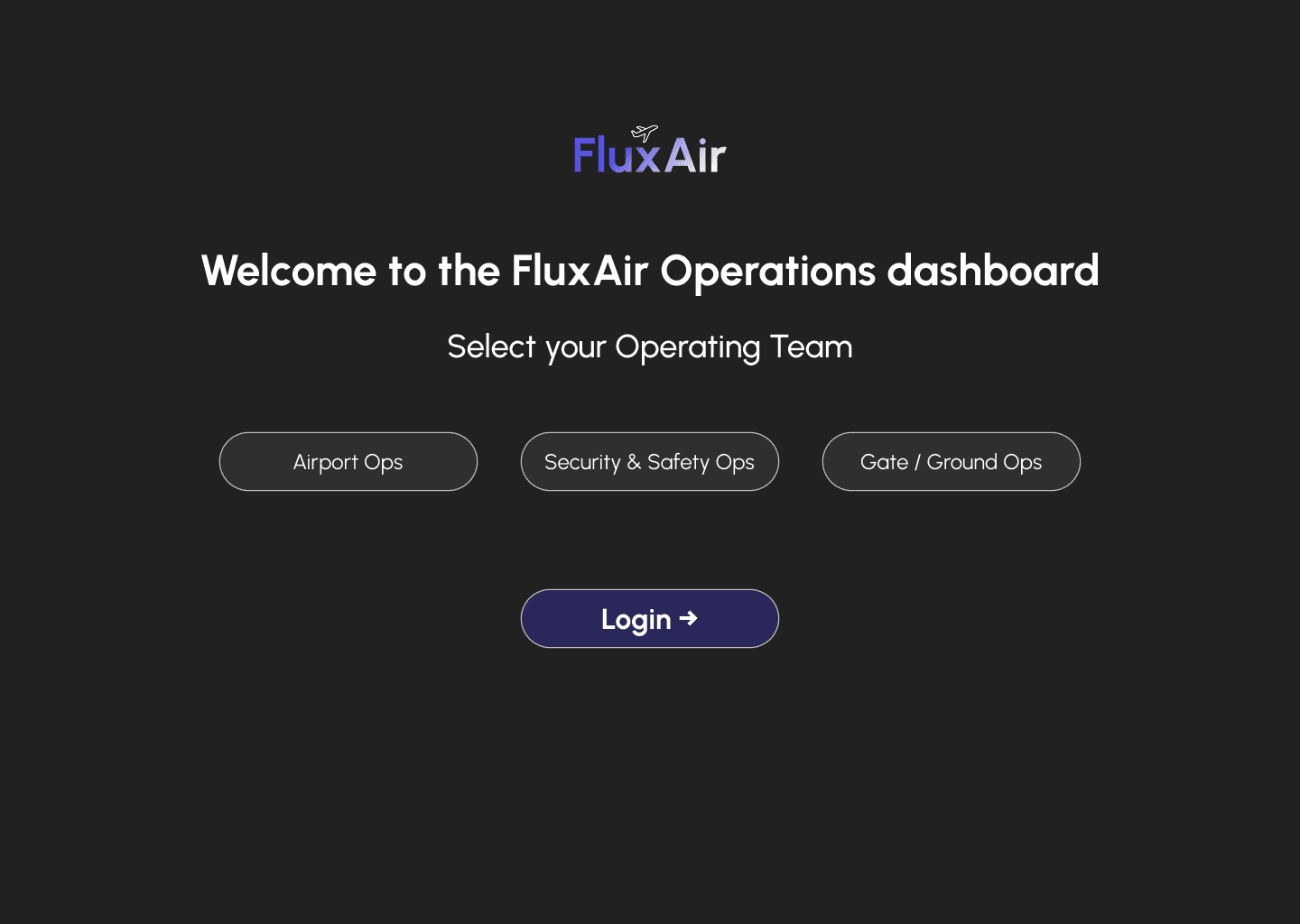
The login experience was intentionally reduced to a single decision to minimize entry friction during time-sensitive situations.
The login flow prioritizes Operational Identity over Authentication Complexity, allowing operators to enter the system with the correct context immediately.
The Login Screen
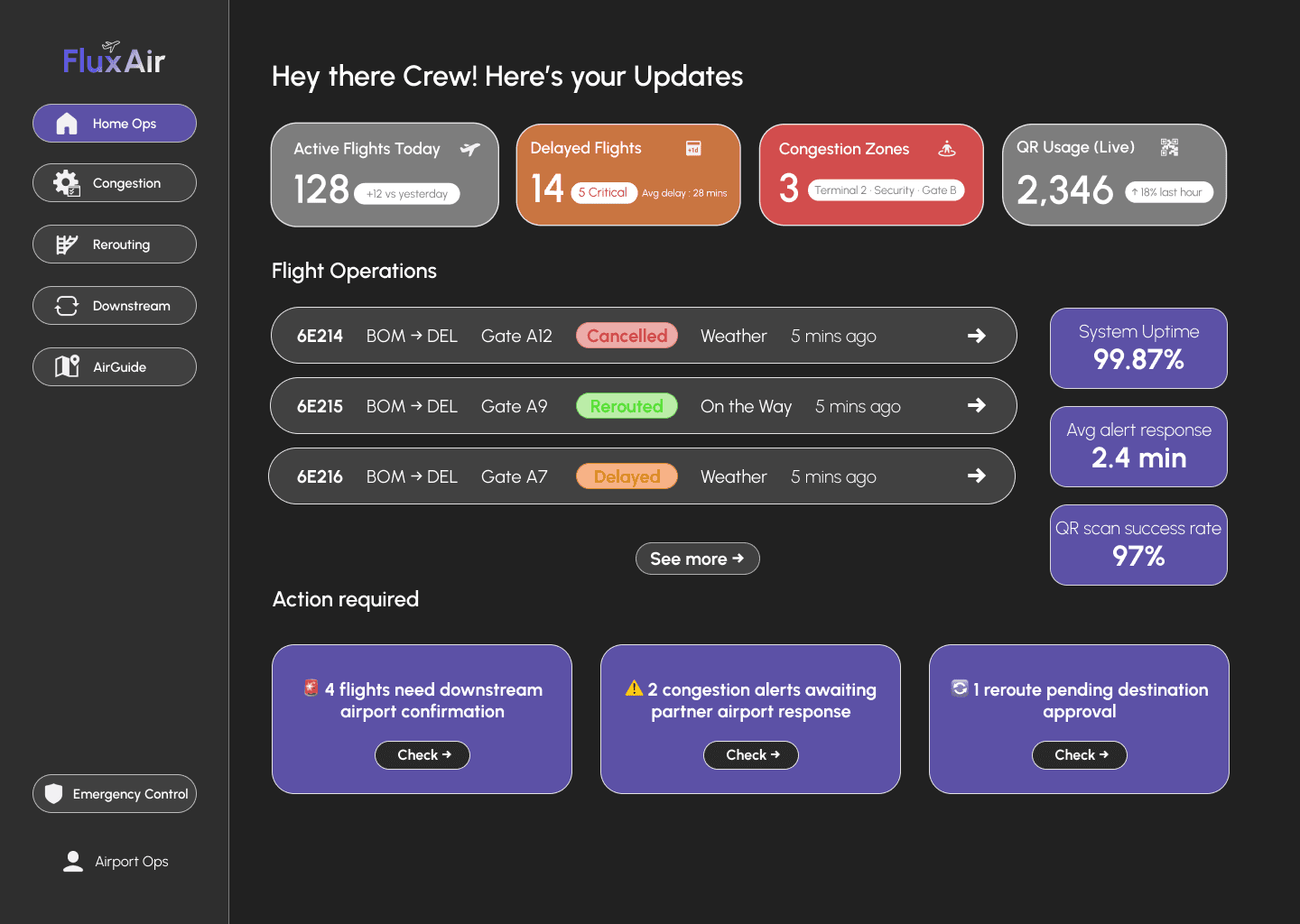
Designed as an Operational Control Entry Point, the Home Ops screen prioritizes Status Clarity and Action Routing over exploratory data visualization.
Metrics are surfaced only to establish operational context, ensuring operators can assess system load without pausing to interpret charts or trends.
All action-required items are consolidated and separated from status information to reduce Alert Fatigue and support fast, coordinated decision-making across teams.
The Ops Inbox
The Congestion screen functions as a Situational Awareness layer, providing at-a-glance visibility into pressure points without introducing decision-making complexity.
Data is structured around Operational Impact and Downstream consequences, allowing teams to quickly assess risk propagation across flights, staff, and partner airports.
Situational Awareness UI
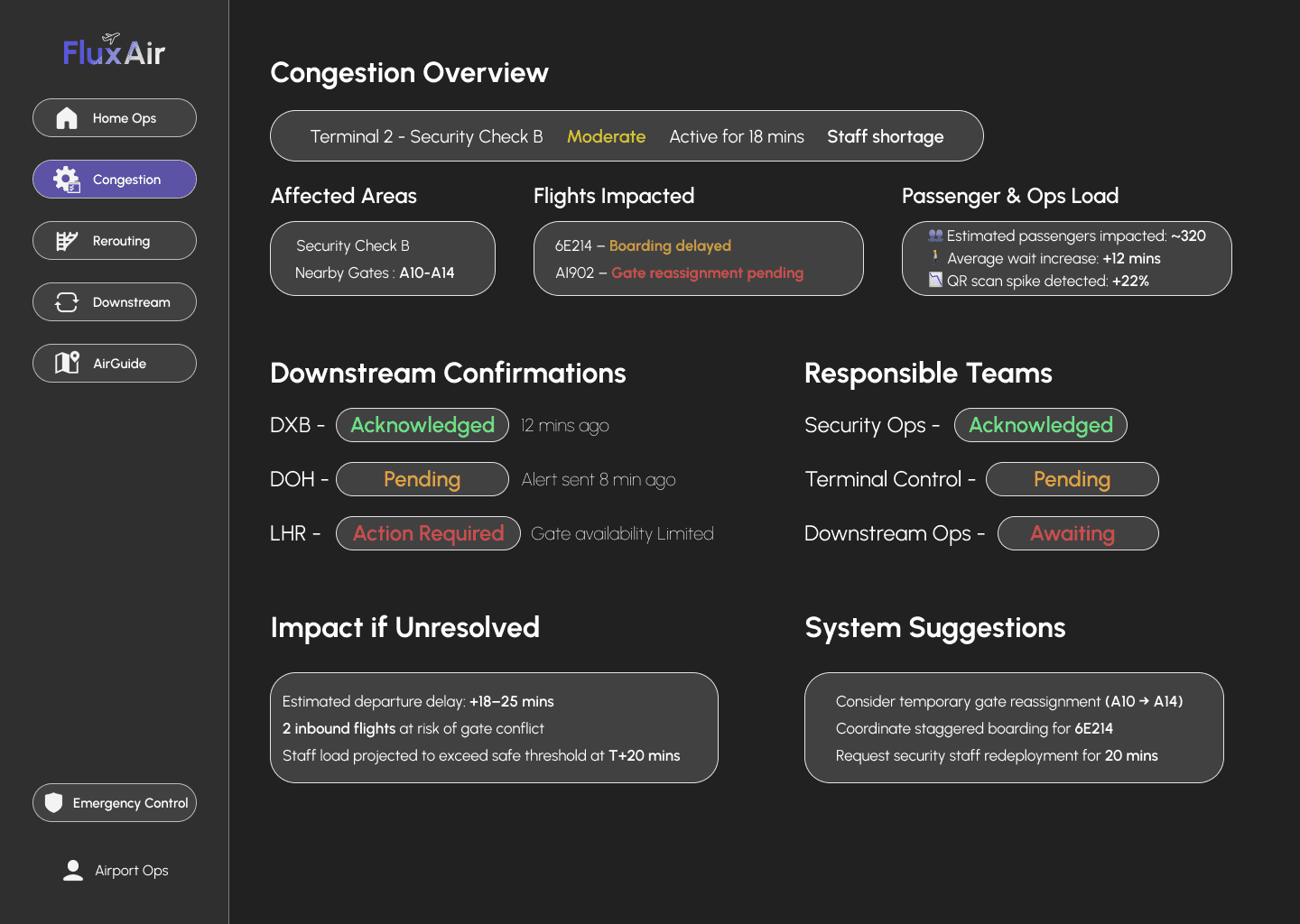
The UI prioritizes visibility over interaction, mirroring operational environments where crews communicate primarily through radio systems rather than constant screen input.
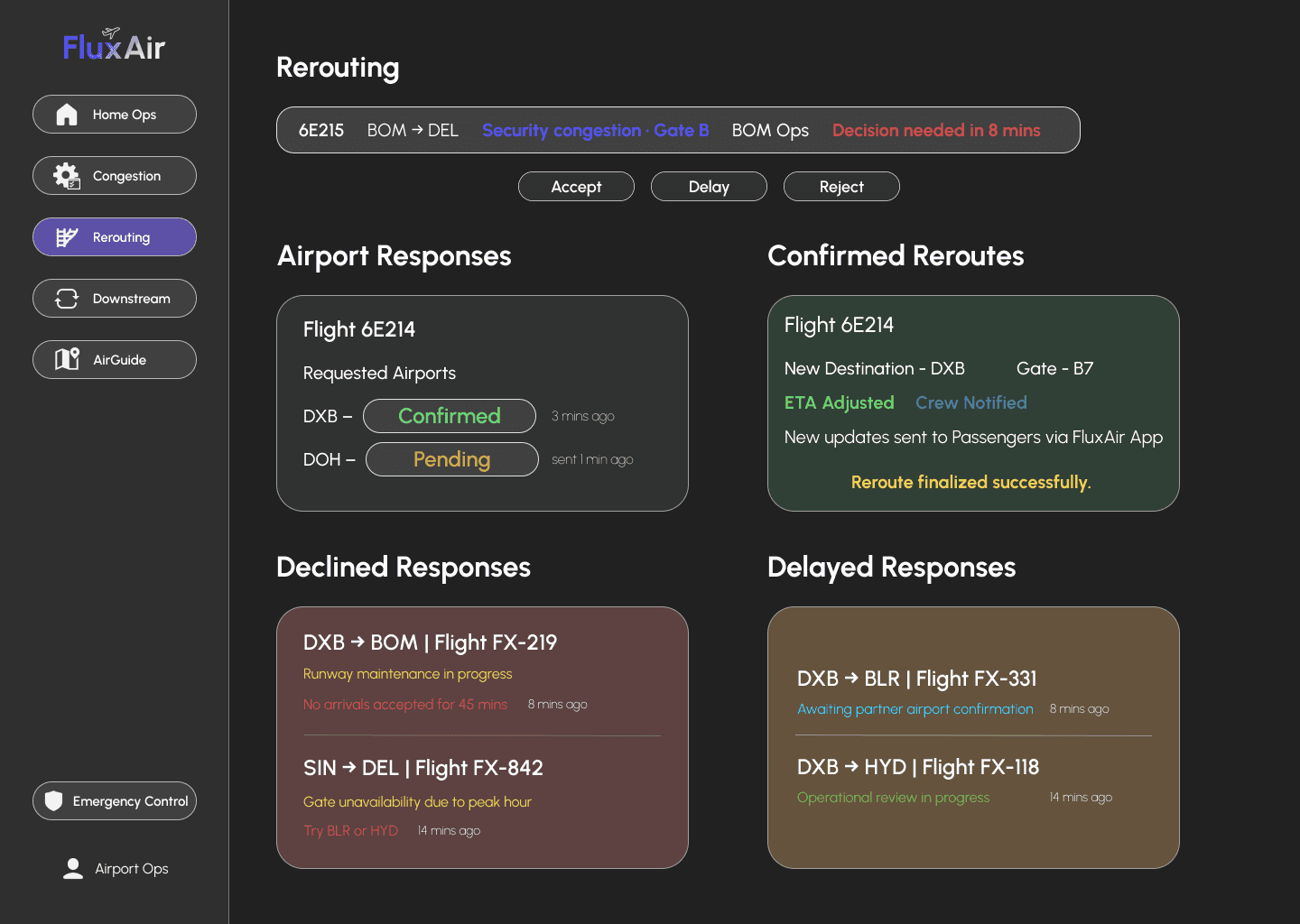
Rerouting is treated as an Exception Flow, not a default action, reflecting the cost and risk associated with involving external airports.
Minimal controls reduce cognitive load during high-pressure scenarios while preserving full decision context.
Coordination and Accountability Hub
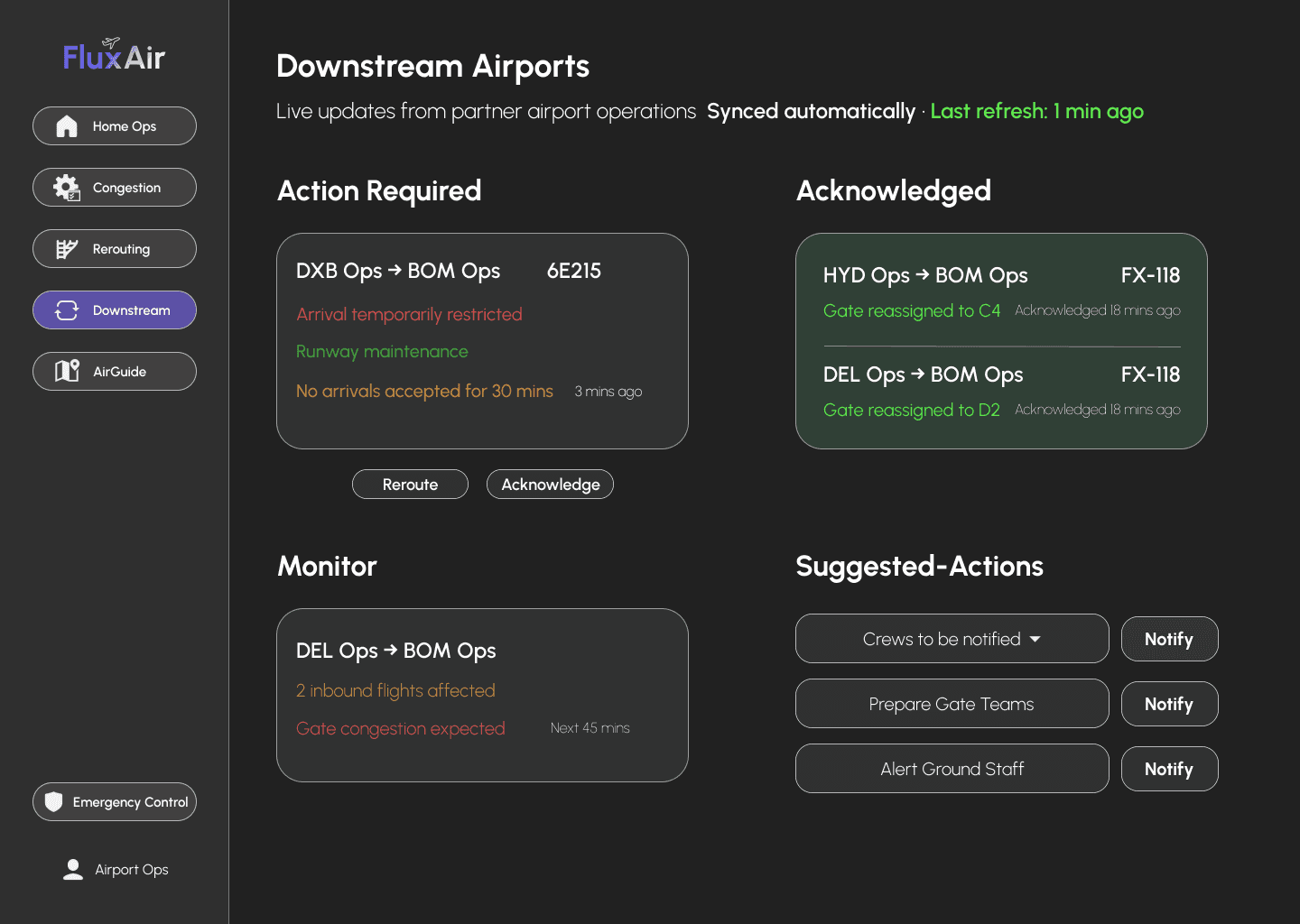
The downstream view surfaces Second-Order impacts, enabling teams to anticipate congestion before it escalates into rerouting or delays.
Suggested actions support Proactive coordination without overriding human judgment in time-sensitive scenarios.
Downstream updates are triaged by Urgency, allowing operations teams to focus only on disruptions that require immediate intervention.
The Operational Triage
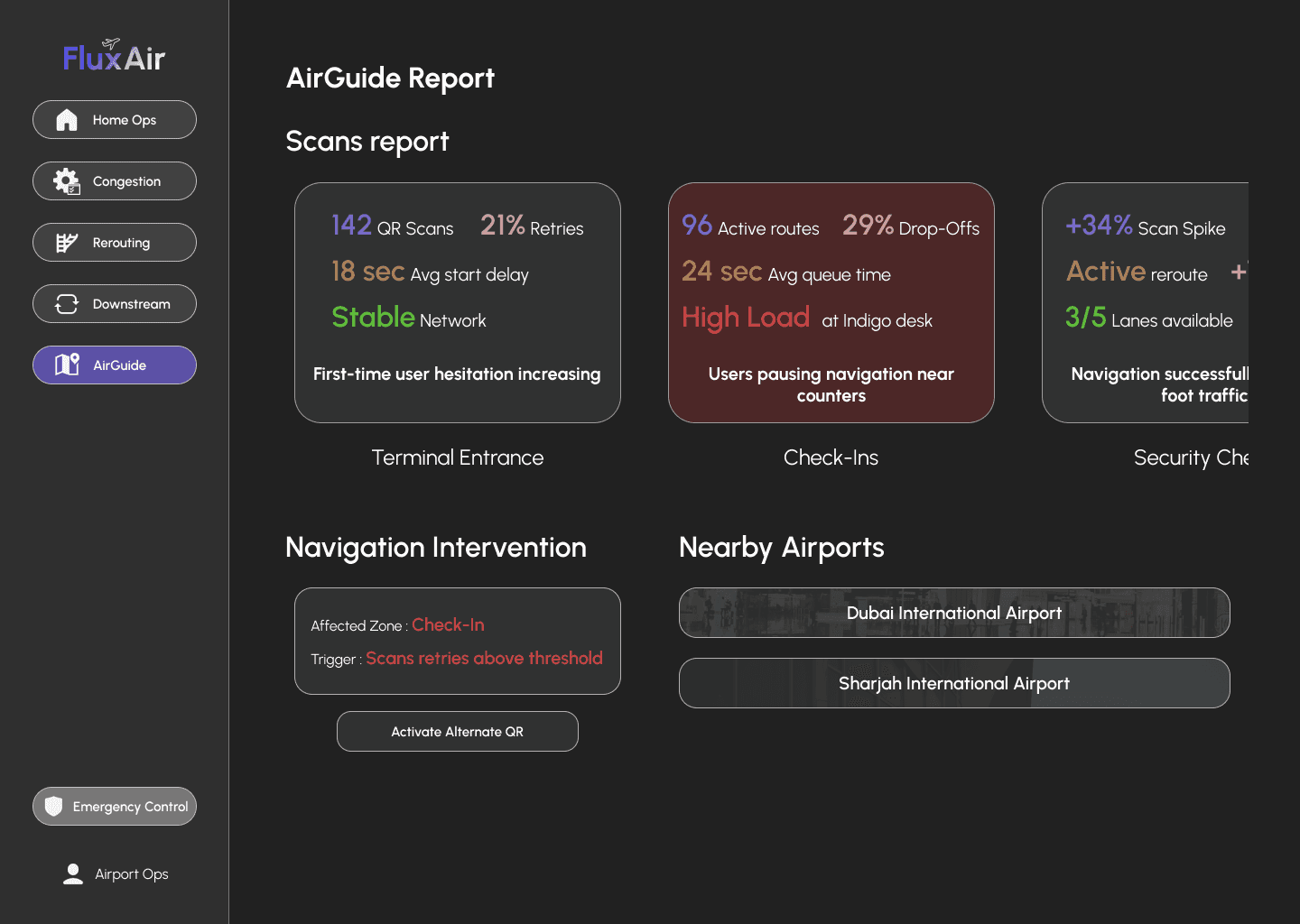
AirGuide connects physical wayfinding data with real-time operational decisions, closing the loop between passenger behavior and airport operations.
Metrics are framed around Operational Impact, translating Passenger hesitation into Actionable signals for ground teams.
Navigation interventions are triggered only when predefined thresholds are breached, preventing unnecessary disruption while maintaining flow.
The Behavioral Ops Intelligence
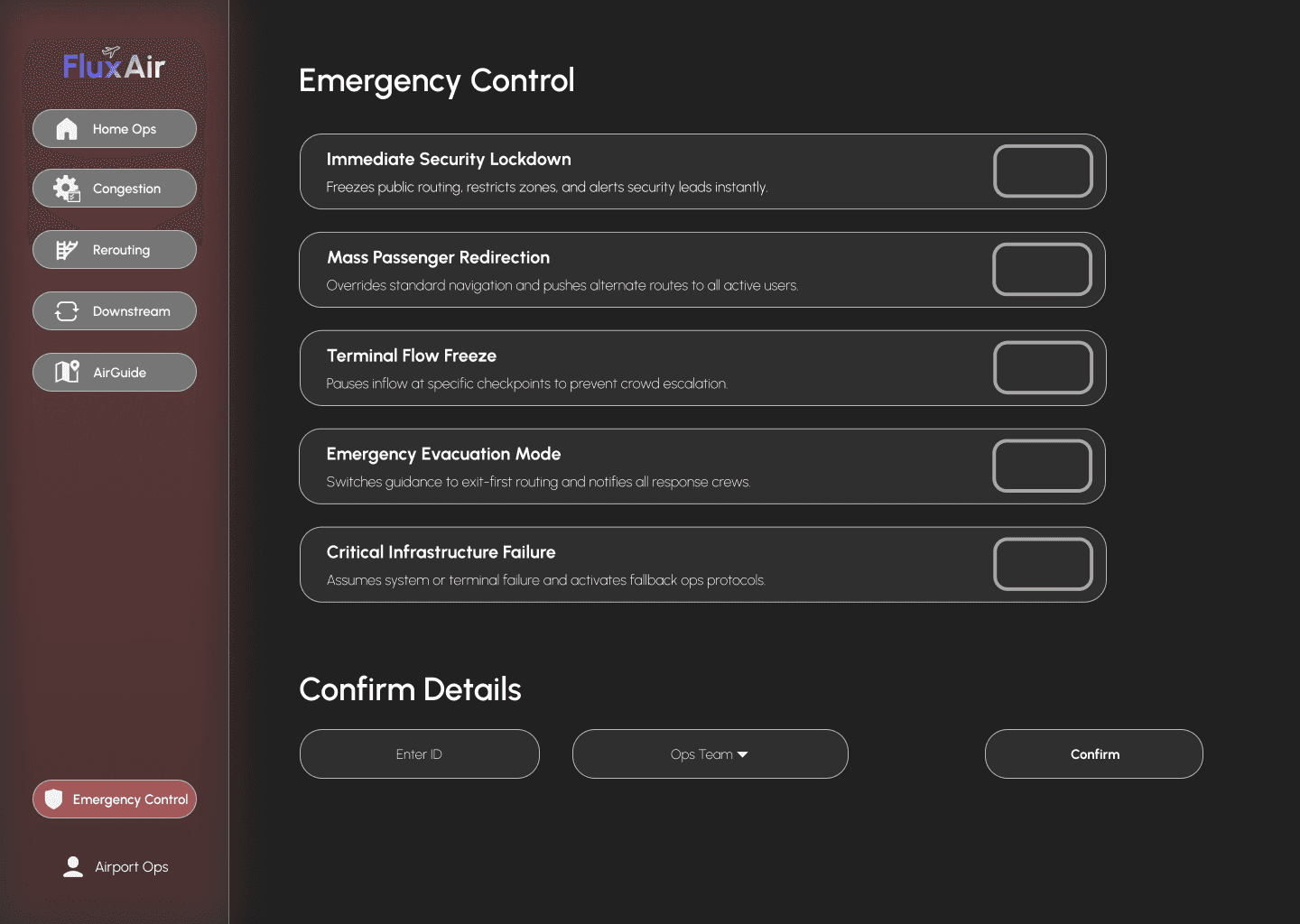
Emergency Control enables Immediate Operational Decisions when supervisory approval is unavailable, ensuring response speed without blocking on hierarchy.
Emergency Control shifts the entire airport into predefined operational states, aligning passenger routing, crew response, and infrastructure behavior.
The system avoids rigid role lockouts during emergencies, prioritizing Operational Continuity over procedural friction.
Authority Transfer under Chaos
System Thinking Over Screens
Each screen in FluxOps exists as part of a single operational loop, not as an isolated dashboard view.
Information flows from Awareness (Home, Congestion), to Coordination (Rerouting, Downstream), to Intervention (AirGuide), and finally to Override (Emergency Control).
Design decisions favor Intentional restraint, reducing cognitive load and preventing unnecessary actions during critical moments.
Reflection
FluxOps took me somewhere none of my other projects did into the operational chaos that passengers never see. The gate changes, the congestion cascades, the emergency decisions made without a supervisor available. I had to research how airport operations actually work because almost nobody had designed for this specific perspective before.
What surprised me most was how different the design instinct had to be. Every other project I'd built was about comfort and calm. FluxOps was about clarity under pressure removing everything that wasn't immediately actionable, designing for speed over aesthetics.
The UI reflects where I am as a designer. But the thinking behind every screen reflects exactly who I'm becoming someone who designs for the person nobody thought to design for.
BookNest
Hold & Heal
FluxAir
The Other Side of the Terminal
FluxAir solved the passenger's anxiety. But the more I designed it, the more I kept thinking about the people making it all work the crew managing congestion, rerouting flights, coordinating across terminals, handling emergencies without always having a supervisor available.
Passengers feel overwhelmed for a few hours. Crew members live in that pressure every single day.
That asymmetry felt worth designing for. So I built the other side of the same ecosystem not a companion app, but a completely different interface for a completely different kind of user under a completely different kind of pressure.
That became FluxOps.
A crew operations dashboard built as the B2B backbone of FluxAir - what the airline staff sees while passengers use the app.
Problem : Airport ground crew tools are fragmented, outdated, and not designed for real operational pressure.
My role : Designed the companion system to FluxAir same ecosystem, completely different user mental model.
Key decision : Treated it as a separate design problem, not just "the admin view" because crew users need density, not simplicity.
Honest outcome : This case study shows I can think in systems across both sides of a product.
Summary Card
Real Voices Over Vanity Metrics
These aren't statistics, they're the moments that don't show up in dashboards. Every feature in FluxOps was built in response to a real operational frustration, because the best design decisions come from listening, not assuming.